
C++23: Slicing with std::views::chunk
One of the common use cases in programming involves extracting fixed size chunks from a given sequence and operating on them. Not a big deal at all. As a C++ developer, I have coded this quite often and have wished that the language had a built-in function for this. Fortunately, C++23 gives us std::views::chunk to simplify and standardize this use case.
The following example shows how this is done.
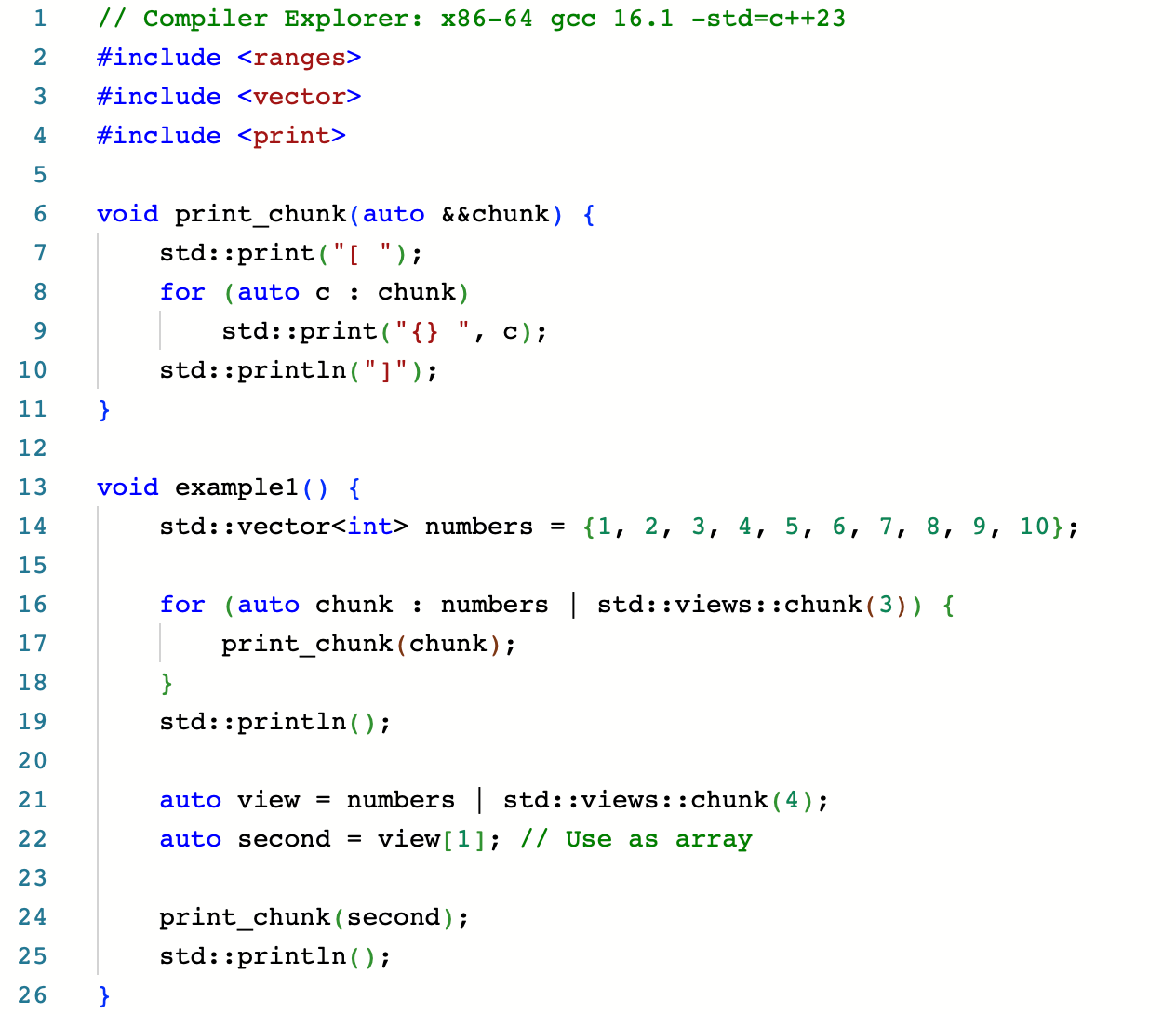
In the above, we extract 3 elements at a time from the given vector and print them. Next, we chunk in terms of 4 elements at a time. Treating this collection as an array, we extract and print the elements at index 1.
Here is the output.

It is important to understand that std::views::chunk is a “lazy adaptor”; no unnecessary allocation or copying is done until we evaluate the underlying range. This has a significant impact on efficiency.
In the following example, we generate an infinite sequence of integers and take only the first three chunks, where each chunk has 4 elements.
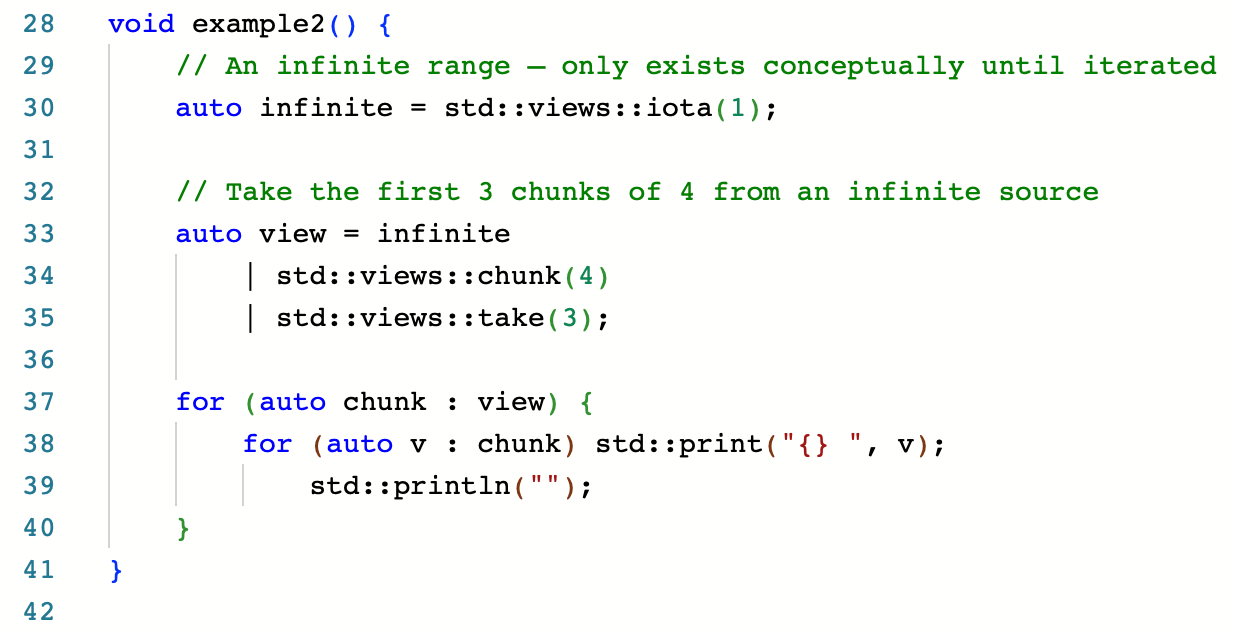
Here is the program output:

The next example uses another useful range adaptor – “stride”. This was also introduced in C++23 and it produces a view of every “Nth” element of an underlying range.
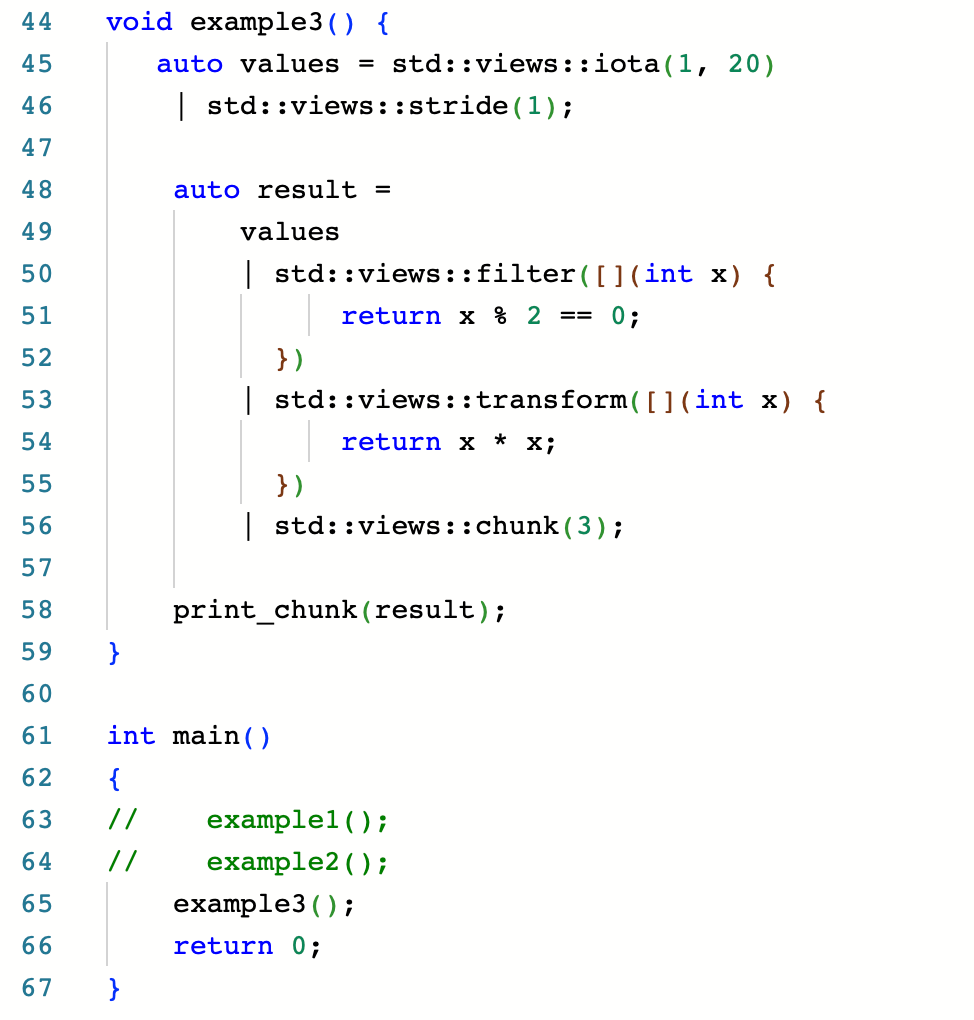
Notice how we are able to cleanly use the “pipe” operator for composing different functions – another elegant testimony for the evolution of C++ from its earlier days1
Here is the output for this example:

As the above examples demonstrate, “chunk” is a simple but useful function in the C++23 standard library.
I used compiler explorer for this experiment.
Have a great day!